Posts

Showing posts with the label Ranthambore

Pesky peacocks and the hungry tigress

Image
Early in the afternoon we saw the tigress disappear into a tall clump of grass lining the lake’s edge. When she didn’t re-emerge even after 20 minutes, we deduced that, she is planning to hunt. The deers come to the bank of the lake to drink water in the late afternoon and it would present a perfect opportunity for the tigress to stalk and hunt. Excited, with the prospect of watching the hunt from close, we selected a spot diagonally opposite to the patch of grass and started a vigil . Intermittently, we could spot her in the grass, when she would raise her head to check the movement of the deers. After a wait of nearly 1.5 hrs, with the dusk approaching, appeared the pesky peacocks. One of them soon spotted the tigress and immediately started a alarm call, initially in a low volume which kept climbing higher and higher with the other two joining in a chorus, alerting the deers nearby. With her cover blown and prospect of a meal disappearing, eventually the tigress came out of hiding, ...
Best Places to find tigers in India

Image
If you have seen a tiger in the wild, then you already know how exciting it is and if you have not, then it is time you did.😃 Tigers are arguably, one of  the most beautiful animals on the earth. As I tell everyone (whoever is ready to listen) that – if God exists (I happen to be agnostic) and created all the life on earth, then probably God stopped after creating the tiger as nothing could surpass the beauty, grace and swagger of a tiger. The Bengal tiger, also known as the Royal Bengal Tiger or the Indian tiger, is the subspecies with the largest population. It is the national animal of India. India is now home to over 70% of the Tiger population in the world and perhaps the only place where you can see tigers in the wild. Tigers in India are mostly found inhabiting six different forested landscapes—Shivalik Hills and the Gangetic plains, Central India, Eastern Ghats, Western Ghats, North-eastern Hills and Brahmaputra plains, and Sundarbans—with different topographical features....

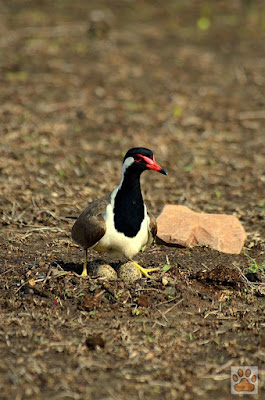
A Red Wattled Lapwing guarding her precious eggs.

Image
She was concerned because she had spotted a juvenile Monitor Lizard checking out her eggs. We watched her face-off with the lizard, but due to my poor photography skills the images of the confrontation did not come out well. They are found near to water bodies, fields, dry lands and lakes. Though, they can be easily seen in wild and open grasslands looking for insects. Mostly, this bird is found in pairs or small groups. Its striking appearance is supplemented by its noisy nature, with a loud and scolding Ti-Ti-Ti-Ti call. Their breeding season is mainly March to August. The courtship involves the male puffing its feathers and pointing its beak upwards. Several males may display to females. The eggs are laid in a ground scrape or depression sometimes fringed with pebbles, goat or hare droppings. They soak their belly feathers to provide water to their chicks as well as to cool the eggs during hot weather. The eggs hatch in 28 to 30 days. Egg mortality is high due to predation by lizard...

What tigers think about so deeply

Image
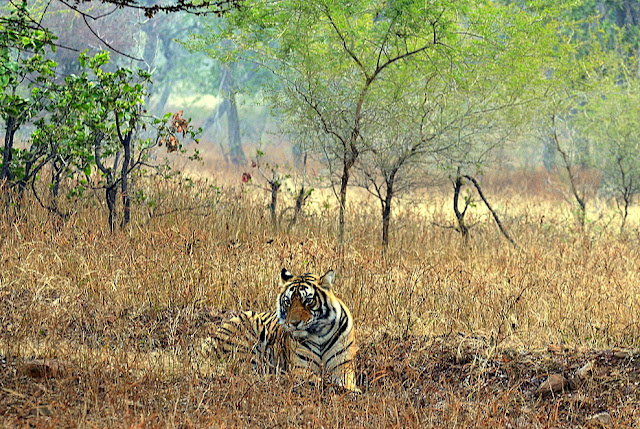
  I often wonder what the tigers think about. I have seen many a times tigers in deep thought like this one here. You could also possibly feel the contemplative stare and body posture. We found him sitting in deep thought on a misty February morning. Even though our car was stationed very near to him, he did not look up at us for a long time. What I do know that this was a sub-adult – almost adult male tiger. They generally stay with their mom for about 2 – 2.5 years sharing a deep bond and love. And then one day they realize that the time is approaching for their separation. This is probably more painful for the male cubs than the female ones. The female cubs tend to settle nearby and most cases steal / occupy an area from her mother, so there will be some element of rivalry once they grow. The male cubs on the other hand have to move far off from their mother, lest they encounter other larger males and get killed. Was this cub thinking about his impending separation and the inev...